Showing posts with label Ingrid Mida. Show all posts

Creative Process Journal: Curation and Obsessions


From a curatorial perspective, finding a narrative from among the hundreds of dresses in the Ryerson Fashion Research Collection that come from different donors and span over a century of fashion history is a challenge. 

Garments represent important artifacts of material culture, giving evidence of the fashions and social history of a period. Museologist Susan Pearce describes the way objects can reflect our identity: "Objects hang before the eyes of the imagination, continuously representing ourselves to ourselves and telling the stories of our lives in ways which would be impossible otherwise" (qtd. in de la Haye 12). 
Clothing is material memory, carrying the marks and imprint of its wearer. Quentin Bell described clothing as being so much part of one’s identity that “it is as though the fabric were indeed a natural extension of the body, or even of the soul” (qtd. in Dant 85). The clothing that is kept beyond its fashionable life often has “symbolic qualities” and holds “personal memories” for the owner (de la Haye 14). In a poetic essay by Peter Stallybrass entitled “Worn Worlds: Clothes, Mourning and the Life of Things”, the author describes how the clothes of his late colleague Allon White triggered sensory memories. “He was there in the wrinkles of the elbows, wrinkles that in the technical jargon of sewing are called ‘memory’; he was there in the stains at the very bottom of the jacket; he was there in the smell of the armpits” (36). 
            If I draw on my obsessions as suggested by curator Maria Luisa Frisa, those centre on the traces of the former owners of these garment within the archive itself. Very few pieces have any associated photos or letters, making those that do have fragments of their history as evidence take on even greater importance, especially as some of them are extremely fragile. In my work, I've discovered: the wedding dress worn by Mary Suddon for her wedding in 1955 to Alan Suddon, an important collector of historical costume in Toronto, along with a box of bodices and gowns from the late nineteenth century donated to the collection by Alan Suddon; a set of three gowns designed in Paris and worn to the coronation of King George V; and, a Balmain gown labeled “Marie Antoinette” c.1957 donated by socialite Somer Rosenberg. 


There are also many historic pieces from the turn of the century that lack provenance but which bare traces of their former owners, in the faint stains of sweat under the arms, in the worn patches on the elbows, and in the shreds of silk that threaten to disintegrate into dust.  Yet there is a haunting beauty emanating from these pieces, an uncanny reminder of the former owners. 
Curator Judith Clark's reference to the "double loss of life" in terms of "the garment without its body, and the garment out of sight, embedded within an archive" (from The Concise Dictionary of Dress which has no page numbers) haunts me. In fashion exhibitions, the viewer almost never sees the archive. Garments are typically presented in a pristine state and evidence of the wearer, in terms of stains, rips or tears, would make a garment ineligible for display. 
It is this gap that excites me. The first time I went behind the scenes in a museum, at the musée de la Mode de la Ville de Paris in Paris,  my heart literally pounded in my chest as treasures in storage were revealed to me. Only a small fraction of a museum's collection can be made visible to the public. And now when I examine an unmarked bin in the archives or can share a garment to a student related to their research as part of my job as Collection Co-ordinator, I get that same heady frisson of excitement. This is what I want to share in an exhibition.... 

Dant, Tim. Material Culture in the Social World. Philadelphia: Open University Press, 1999. Print.
De La Haye, Amy. A Family of Fashion: The Messels: Six Generations of Dress. Eds. Lou Taylor and Eleanor Thompson. London: Philip Wilson Publishers, 2005. Print.
Stallybrass, Peter. "Worn Worlds: Clothes, Mourning and the Life of Things." The Yale Review 81.2 (1993): 35-50. Print.

Creative Process Journal: Weekly Reflection

This past week, I've been documenting some of my reading on curatorial process, teasing out the fragments of how curators come up with exhibition ideas. It might not seem like creative work, but it is part of my practice-led research project called Memories of a Dress. Using the Ryerson Fashion Research Collection, I am exploring the idea that a garment has a object biography and a memory of its former owner.  

Practice-led research focuses on the "the nature of practice and leads to new knowledge that has operational significance for that practice." From what I can tell, there seems to be a gap in knowledge about the process of how fashion curation takes place. The articles in scholarly journals only offer hints at how curators come up with their ideas and unless I've missed something altogether, this process seems to be largely private. In undertaking this work here, I am making my process transparent  and thereby adding to the advancement of knowledge about curatorial practice. 

If I could, I would mount Memories of a Dress in a space that is raw, with exposed brick and pipes.  This wounded setting would be fitting to convey the idea of decay and that a garment has an end-life, just as its owner does/did. Unfortunately, the School of Fashion does not have a dedicated exhibition gallery and so the end result will be largely conceptual, with the possibility of selected pieces and images being presented offsite. 

In handling the rare and fragile historic pieces within the collection, I am haunted by the traces of the owners - the faint sweat stains under the arms, the worn patches at the elbows, the shreds of weighted silk that have literally turned to dust. There is such poignancy in these pieces. They are still beautiful, but not to a pristine, museum-like standard. 

As I deal with past and present donors as part of my job as Collection Coordinator, I am also sensitive to the emotional nature of such transactions. There is great delicacy required when a donor offers pieces from his or her wardrobe. Giving up a garment that holds memories of a special time, event, or person requires a willingness to let go of that tangible connection. And because of that, the act of accepting or rejecting that item for a collection requires great tact and diplomacy. 

My own experiences with death, tragedy and grief gives me a heightened sensitivity to the symbolic nature of the embodiment of memory in clothing. In the back of my closet, I keep my father's Fedora, four of my mother's dresses, my brother Peter's tie. I have nothing from my husband's father, my sister-in-law Carrie, or my dear friends Brian, Joe, or Diana, but I wish I did. Although I have transcended my grief, I cannot part with these objects and I am only too keenly aware of the delicate dance I play with potential donors. I am acutely sensitive, with a radar to grief, since I have taken that journey far too many times relative to my age. 

Dealing with donor requests taxes curators who are already stretched by tight budgets. I happened to across a written reference to the emotional nature of this work in an article by N.J. Stevenson called "The Fashion Retrospective" from Fashion Theory. In analyzing curator Amy de la Haye's work she wrote:

Reflecting a moment in time has become one of the central precepts of de la Haye's work. She found that interviews with members of the public offering donations to the museum could mean dealing with profound emotion and grief that was precipitated by the associations that garments had for them (230). 

In sharing the nature of my curatorial obsessions, this project makes me feel vulnerable and exposed. And yet, I know that in mining the nature of my obsession and documenting my process for this practice-led research, the end result will be richer and deeper.

For Further Reading on the nature of Practice-led vs. Practice-based Research:
http://www.creativityandcognition.com/research/practice-based-research/differences-between-practice-based-and-practice-led-research/ 

References:
Stevenson, N.J., "The Fashion Retrospective". Fashion Theory 12.2 (2008) 219-236. 

What's on the September 2012 Fashion Calendar?

Smythe Warbler Tribute Blazer
September means the end of lazy summer days and back to school, back to work. Long before Kate Middleton started wearing the hip Canadian label Smythe, their blazers have been favourites in my wardrobe. With a bit of sleuthing and some help from one of my favourite sales reps, I scored the Warbler Tribute Blazer (shown above) inspired by the hit tv show Glee with proceeds to go to support  anti-bullying campaigns in Canada and the USA. This is what is on my fashion radar for September 2012 (and in some cases on my calendar).

September 6, 2012  7-10 pm: Holt Renfrew's 175 Birthday Party 
This Canadian retailer of designer fashion began as a furrier in Quebec City in 1837. Founded by William Samuel Henderson, the shop sold luxurious furs to customers such as Queen Victoria, the Empress Eugenie, Princess Louise, the Princess Beatrice, the Duchess of Albany. As the store evolved, more locations were added and it has become Canada's destination spot for high-end fashion labels. The store will be celebrating its 175th Anniversary with a street party and an outdoor film projection on Bloor Street in Toronto on Thursday, September 6th and the store will stay open until 11 pm.

September 5-13, 2012: Mercedes Benz NewYork Fashion Week Spring 2013 Collections
Spring 2013 Collections will be launched September 5-13 in New York. The line up includes American classic designers like Ralph Lauren, Calvin Klein, Michael Kors, Donna Karan, Chado Ralph Rucci, Zac Posen, Diane Von Furstenburg, Tory Burch. I am sure they will all be fabulous, but what I really want to see is the finalists from Project Runway on September 7, 2012 at 10 am....

September 6-16, 2012: Toronto International Film Festival 
Toronto has become one of the leading international festivals for the launch of films and the celebrities usually get glammed up for their walk on the red carpet. In the 37th year of the event, there will be 289 films shown over 11 days of the festival. I will attend two of the gala events and I am already wondering what to wear....

September 17, 2012: Andrew Bolton presents a lecture on McQueen: A Case Study of Curatorial Process at the Pratt Manhattan Campus: 144 West 14th St. (Room 213), 6 to 8 pm. Given that people are still talking about the McQueen show at the Met, this event is bound to be a standing room only situation. I wish they were going to live-stream this....

September 18-19, 2012: Design Intelligence; Fashion New York is a two-day creative event for 100 key players from the international fashion industry and its periphery to share knowledge to encourage sustainable design and business practices. I will be one of the participants and am looking forward to the 15 international keynote speakers including Hazel Clark of Parsons The New School of Design and Sarah Scaturro of the Cooper Hewitt National Design Museum.

Photo courtesy of Smythe.

Embroidered Fashion Illustrations for Selvedge Magazine

Not long ago, I was contacted by the editor of Selvedge Magazine asking if I would take on the assignment of creating illustrations for story about Lyon silks. Even though I no longer have a separate website for my artwork, Selvedge editor Polly Leonard had found selected images of my embroidered 18th century dress illustrations on the web and wanted me to create similar images for an upcoming issue. Being swamped with other work, I initially declined. Even so, Polly convinced me to give it a try and  few days later I was glued to my chair in my studio, working frantically away to get the job done for deadline. 

Blinded by desire by Ingrid Mida 2010
I won't bore you with the details, but it was a rough go. My hands ached, my head hurt and at times I thought I was going blind. I even tried to fire myself at one point, but like most things worth doing well, it took longer and required more revisions than I expected. In the end, we were both happy and the illustrations will be published in the September issue of this London based publication. If you haven't seen a copy of Selvedge magazine before, it is lush with colour photos and illustrations of the most beautiful textiles. Their motto is "The Fabric of your life: textiles in fashion, fine art, interiors and shopping". A single issue of the e-magazine can be viewed online here (look for the Etiquette issue #48 if you want to see my illustrations).  The September issue of the newsletter features my work as well.

Madame des Pouffs by Ingrid Mida 2009
The images shown above are not the illustrations I created for the magazine but are examples from the series. In this work, digitally altered images of upper class18th century men and women are layered over traditional French toile de jouy fabrics to create an interplay between the fabric and the figure. Embroidery and beading is selectively incorporated to highlight certain areas in the composition. The images appear pretty but meaning is layered into the work in a subtle and playful way. I've worked on this series on and off since 2009 and sold works to customers in Italy, England, Canada and the USA. Admittedly the work for Selvedge was a little more conventional than what I've shown here, but it is a joy to embroider, and something that I rarely have time for in workweek anymore.

Last Chance to See

The summer is drawing to a close as are a number of exhibitions of fashion in the museum. The list includes:

Surreal Body Gallery from Impossible Conversations: Schiaparelli and Prada at the Met
Photo courtesy of the Costume Institute at the Met
Impossible Conversations: Schiaparelli and Prada at the Metropolitan Museum of Art in New York closes TOMORROW Sunday, August 19, 2012. My review of the exhibition was published on Fashion Projects and can be read here.

Tutu Cozy by Svetlana Lavrentieva
Photo by Setareh Samadi
The Tutu Project and Sixty Years of Designing the Ballet at the Design Exchange in Toronto will both close on Saturday, September 2, 2012. In celebration of the sixtieth anniversary of the National Ballet of Canada, these two exhibitions together provide a whimsical portrait of the tutu on stage and as a work of art.


Fashionality: Dress and Identity in Canadian Art at the McMichael Gallery, north of Toronto in Vaughan, Ontario closes Monday, September 3, 2012. In this exhibition, curator Julia Pine draws on theorist Roland Barthes' interpretation of clothing and adornment as “vestimentary code" because it conveys gender, class and cultural heritage. This exhibition features a number of Canadian artists who have used clothing for "its expressive qualities" and relationship to Canadian identity.

Marc Jacobs
Louis Vuitton and Marc Jacobs at Les Arts Decoratifs in Paris closes Sunday, September 16, 2012. This exhibition traces the legacy and relationship between Louis Vuitton and Marc Jacobs. Marc Jacobs, who is not a fan of fashion exhibitions said: "I always find it a bit difficult to deal with the idea of fashion and museums and I've said that before. And I think curators have a kind of cerebral, heady, comparative narrative thing going on. For me the reward of doing what we do is doing it, not when it's done. And when people wear it and love it and covet it or can't wait to have it, whatever it is. So I think my attitude towards the whole thing was that I was very flattered, but how do we make this experience of what fashion is all about - which is the joy."

Online Historic Costume Collections

In a click of a mouse, I can visit the historic and contemporary costume collections from around the world. Although some museums and university collections welcome visiting scholars, digitizing a collection reduces the handling of fragile garments and also offers everyone a chance to see garments that are not on display.  Here are my top picks of accessible collections (click on museum name for related link): 

Dior 1947 Bar Suit, Image Courtesy of the Metropolitan Museum of Art Costume Institute
Metropolitan Museum of Art Costume Institute Collection: The Met has over 35,000 costumes and accessories in their collection, with the earliest piece going back to the 15th century. This New York museum sets the gold standard for online digitized collections, providing multiple images and extensive descriptive information and provenance details for each item.

Victoria and Albert Museum Collections:  Although the storage and research facilities for this London based museum collection are currently being renovated (scheduled to reopen in October 2013),  the V&A website gives access to images from their extensive costume collection and also provides videos, articles, suggested books, and related material. An inviting and friendly website, the fashion related section is organized by period, with links to all related material available on the site. Like the Met, the information provided for each fashion item is extensive, including multiple viewpoints, photos of related accessories, marks and inscriptions and exhibition history. 

FIT Museum Collection: FIT Museum currently has over 50,000 garments and accessories in its collection. Although they have pieces going back to the 18th century, their focus is on contemporary fashion and they seek to add new pieces that "make fashion history". They have an extensive online collection and are adding to that regularly.  FIT has a smaller study collection of approximately 1200 pieces that is accessible to students, faculty and visiting researchers.

Kent State University Museum: Kent State has one of the largest study collections in the world with over 40,000 pieces including historic pieces from the 18th and 19th centuries to the present. While only a small sampling of items have been digitized, this museum believes in accessibility and welcomes students, faculty and visiting researchers.

Drexel University Historic Costume Collection: An online collection featuring detail closeups and 360 degree views of 129 selected pieces from the collection. Of particular note are the photos related to the conservation of an 1885 gown by Charles Frederick Worth (link here).

Chicago History Museum Costume & Textiles Collection: This museum's costume collection includes over 50,000 costumes and textile artifacts from the mid-18th century to the present, and is one of the largest in the world. Recently launched, the digital collection features multiple views of nearly 400 costume and textile artifacts.


Raquel Gaudard Interviews Me about Fashion as Art in the Museum


Not long ago, Brazillian journalist and editor Racquel Gaudard contacted me for an article she was writing for the publication Duetto. Her article was published last month and can be viewed here. Even if you don't understand Portugese, this publication is filled with beautiful imagery. Racquel also kindly provided me with a translation of the article into English for my blog.


When fashion in the museum became a synonym of art
By Raquel Gaudard

The 2012 calendar is full of great fashion exhibitions not to miss, however, the most awaited are – once again – happening far from Brazil.

The Metropolitan Museum of Art (MET) presents in New York, from May 10th to August 19th, “Schiaparelli and Prada – Impossible Conversations”. Elsa Schiaparelli and Miuccia Prada, parted by time and linked by style connections, get an exhibition that shows how both explored different angles of similar issues in their collections.

Heading to the old world, specifically to Paris, the Les Arts Decoratifs is ready to open its doors and face a huge line of fashion lovers, coming from all parts of the world – that´s what the exhibition  “Louis Vuitton - Marc Jacobs” is expecting – from March 9th to September 16th. In view of the extended time, the foresights point to a success as great as Alexander McQueen´s show, last year. Almost 700 thousand people passed by the event, a great amount, specially if we consider the contemporary art audience.

“Fashion exhibitions are in fashion”, says Ingrid Mida, Canadian artist and researcher of the intersection of fashion, art and history. “Fashion attracts young audiences into museums, and savvy curators are aware of the seductive power of staging exhibitions that will bring people into the museum”, she analyses.

Ingrid reminds us that it was Diana Vreeland who first presented, in a museum, the work of an living fashion designer, in 1983, when she showed off an Yves Saint Laurent retrospective, at the MET. “That exhibition generated a lot of controversy, but also set a precedent that others have since followed”. For Mida, fashion shows are more accessible to the mainstream perception than the traditional contemporary art installations, fact that explains – in her point of view – the big audience created by these events.


While abroad, fashion and arts have conversations in many dates spread all over 2012 calendar (check out our highlights for this year in the box, at the end of the report), in Brazil, this kind of production is still restricted to a more historical than artistic speech. The Costume and Textile Museum from the Feminine Institute, at Salvador city (BA), has the largest costume collection of the country, including, sometimes, special guides aimed at the dialogue between fashion and contemporary art – as proposed in the exhibition “Threads, threads, threads”, closed on March 22nd.

But this is an odd case and doesn’t describe the reality of our museums. According to Douglas Negrisolli, brazilian independent curator and art historian, the relation between fashion and visual arts in Brazil is still superficial. “The exclusiveness and the power of a small portion of the society are notorious in our country, and that comes about with much less strength in countries like United States, where the cultural production is extensively supported by both the government and private sector” – he considers.

Douglas also mentions how collections are limited to more regional representative costumes, such as cangaço (symbolical historical way of life from the Brazilian northeastern) and cerrado (typical brazilian vegetation), but, in the long run, “they are ineffective on the process of spreading brazilian costumes main feature, as well as its permanency in presentations”, he thinks.

About the art curator role due to this new work source, Ingrid Mida affirms that this professional acts as a gatekeeper into the museum, once through this selection of which and how objects are supposed to be displayed, he or she can change the public comprehension of art. “Schiaparelli and Prada”, for instance, is directed by no one less but the cineast Baz Luhrmann, who produced a video installation simulating an imaginary dialogue between the fashion designers. 


“Staging effects, such as the use of lighting and sound elements, invisible supports for garments, or animated mannequins, are display techniques for fashion objects that create the aura of an art installation. And, while audiences might read fashion as art because of those choices, it does not mean that what is shown in the context of a museum setting is necessarily art” – she completes.

In Douglas’ opinion, the art curator has the power of highlighting a production, but not raising it to another level. “Just as a physic reaction of an artist/stylist internal desire, in essence, is, on itself, an artwork”, he says. Concluding, he affirms that, in his opinion, “art is the expression of an intimate wish towards to something physical, visual, touchable” – so, clothing would also be, in a way or another, whether valued for installations around or not, included in these words.

BOX:
LOUIS VUITTON- MARC JACOBS
Museé des Les Arts Decoratifs – Paris
From March 9th to September 16th 2012
www.lesartsdecoratifs.fr

ELSA SCHIAPARELLI AND MIUCCIA PRADA – IMPOSSIBLE CONVERSATIONS
Metropolitan Museum of Arts (MET) – New York
From May 10th to August 19th 2012
www.metmuseum.org

CHRISTIAN LOUBOUTIN RETROSPECTIVE
Design Museum – London
From March 28th to July 1st 2012
www.designmuseum.org

YSL – THE RETROSPECTIVE
Denver Art Museum – Denver
From March 25th to July 8th 2012
www.ysldenver.com

BALLGOWNS: BRITISH GLAMOUR SINCE 1950
Victorya & Albert Museum – London
From May 19th to January 6th 2013
www.vam.ac.uk

DIANA VREELAND: THE EYE HAS TO TRAVEL
Palazzo Fortuny – Venice
From March 10th to June 26th 2012
www.museiciviciveneziani.it

What I'm Reading ....

Summer is my time to read. I love to lay in the backyard on a chaise and catch up on my reading.... Hot off the press from Berg are two new titles that dovetail my research: Fashion and Art as well as Victorian Fashion Accessories.


In Fashion and Art, editors Adam Geczy and Vicki Karaminas have compiled a selection of essays by leading scholars including Valerie Steele, Hazel Clark, Joanne Eicher and Diana Crane on the intersection of fashion and art. To date, papers on the topic were difficult to find and this book provides a comprehensive overview of the state of the discourse thereon. My initial review of this book indicates that Valerie Steele's essay on Fashion and Art in this book mirrors her comments in Milan as well as my interview with her for Fashion Projects. I am looking forward to digging deeper into these essays, especially since this is a topic that I am passionate about. 


In Victorian Fashion Accessories, Ariel Beaujot, who did her graduate studies at the University of Toronto, considers the history of women's fashion accessories such as the parasol, the glove and the fan during the Victorian era. Turning a phd thesis into a book that is accessible and interesting to non-academics is no small feat, and so far this book has been delightful, providing that necessary balance between scholarly research and general interest reading. In my own research on the paintings of James Tissot, I've noted that the glove and parasol figure prominently in his works, and I'm looking forward to understanding the nuances of meaning in the depiction of these accessories with the help of this book. 

Report from Milan Fashion Tales 2012

Dolci is the word I would use to describe my trip to Milan Fashion Tales 2012. It was three days of intense focus on fashion theory and I took it all in like a sponge. Funnily enough, many people said to me "You look familiar" and when I'd admit that I was the author of "Fashion is my Muse!", they would often laugh and said they had visited before. It seems that my slog (scholarly weblog) is a fashion academic's guilty pleasure.....
The Duomo in Milan, Photo by Ingrid Mida 2012
The conference was kicked off by fashion scholar Valerie Steele who gave a talk entitled "Is Fashion Art?". She had given a similar paper last summer but revised this talk to incorporate the quote from Muccia Prada used in the Costume Institute's exhibit on Schiaparelli and Prada: Impossible Conversations at the Metropolitan Museum of Art. Prada said: “Dress designing is creative, but it is not an art…. But to be honest, whether fashion is art or whether even art is art doesn’t really interest me. Maybe nothing is art. Who cares!

Window of Alan Journo in Milan, Photo by Ingrid Mida 2012
Other highlights of the conference included featured papers by Sophie Woodward on "The Intersecting Narratives in Clothing", Peter McNeil on "Post colonial fashion: Easton Pearson", and Chris Breward on "Music, Image and Style: David Bowie". During the parallel sessions, my favourite papers included: Jeffrey Horsley from London on "Presenting the Body in the Fashion Museum" and Alexandra Cabral from Lisbon on "Art and Fashion". No doubt there were other fabulous papers in other parallel sessions, butI focussed on my interest in fashion and art.

Blumarine Window Milan, Photo by Ingrid Mida 2012
I'm pleased to say that my paper "The Metaphysics of Blogging" was received well to a standing room only crowd. I quoted Agnes Rocamora from the University of the Arts in London and she just happened to be the next speaker on my panel and spoke on "Instant Fashion, Time and Acceleration in the Fashion Blogosphere". Marco Pedroni presented "Fashion Blogs, A New Way of Telling Fashion" and it was suggested that these three papers be published together since they reflect the past, present and future of the blog.

Window of Valentino in Milan, Photo by Ingrid Mida 2012
Milan turned out to be a beautiful city that combines fashion, art and history in its own unique way, and although I seemed to get lost at least once every day, there was always something beautiful around the next corner. The  theme of the city as it relates to fashion came up throughout the conference and there were speakers from countries all over the world including such faraway places as Brazil, South Korea, New Zealand, and Saudia Arabia. The conference organizers are already planning ahead to Milan Fashion Tales 2014.

I "heart" Milan. Photo by Ingrid Mida 2012


Fashion Tales 2012 Milan

This afternoon I will present my paper The Metaphysics of Fashion Blogging in Milan at the Fashion Tales 2012 conference. Of course, I wanted to wear something out of the ordinary and I asked a talented friend - Anna Zygowski - to create a dress for me. She first created a digitally printed silk fabric from photos of distressed lace and then copied a style of sheath dress that I often wear. The fabric presented its own challenges for Anna, but I think the result is fabulous. Even if my paper doesn't get rave reviews, no doubt the dress will!


The abstract of my paper is:

The emergence of the fashion blog is an aspect of culture that has gone largely unexamined. Although fashion blogs seem to be a relatively recent phenomenon, the drive to document aspects of one’s life goes back many centuries. Journals, diaries, sketchbooks and albums are evidence of the urge to memorialize and share ideas, events, activities, and accomplishments. For example, Barbara Johnson, a well-to-do Englishwoman from a clerical family, made detailed notes about her wardrobe for the period 1760-1823. Her album, which is now in the archives of the Victoria and Albert Museum, includes a detailed description of each garment, fabric swatches, information about cost and trimmings as well as clipped pocketbook engravings with the styles of the day. Drawing on historic precedents and the author’s experience as a blogger, blogs are reconsidered in the context of theorist Michel Foucault’s theories on the aesthetics of existence as creative portals for identity construction. In equating bloggers to Walter Benjamin and Charles Baudelaire’s concept of the flâneur, this social media tool is also recast as a forum in which the ephemeral and transitory processes of fashion can be captured. 

What is on the Fashion Calendar in June 2012

June seems relatively quiet compared to this past month! Some of the ongoing shows and events that I would recommend include:

Cristobal Balenciaga: Collectionneur de modes (Gallery Installation Shot by Ingrid Mida 2012)
Cristobal Balenciaga: Collectionneur de modes at the Musee Galliera in Paris
Balenciaga collected garments, accessories, and books from the 18th and 19th century as part of his personal archive. The juxtaposition of these items alongside the contemporary designs created by the Spanish designer show the links between the inspiration provided by history and the end result. This exhibition was so innovative in presentation that I think it is worth a closer look. The curators were creative in their display of items that could only be shown flat due to conservation issues, as well as innovative use of relatively inexpensive design modules. 

Prada and Schiaparelli: Impossible Conversations at the Metropolitan Museum of Art in New York
The imaginary conversation of two women designers -- Muicca Prada and Elsa Schiaparelli -- from different decades celebrates the power of ugly chic as well as the connection between fashion and art. Read my review on Fashion Projects here: http://www.fashionprojects.org/?p=3904


Roger Vivier: Process to Perfection (Gallery Installation Shot by Ingrid Mida 2012)
Roger Vivier: Process to Perfection at the Bata Shoe Museum in Toronto
The delicate jewel-like creations of Roger Vivier remind me of candy. Exquisitely crafted with beadwork and other embellishments, Vivier shoes are truly wearable works of art.

Fashion Tales 2012 in Milan (June 7-9)
If you happen to be in Milan next week, please join me at the Fashion Tales conference at the Universita Cattolica del Sacro Cuore. I will be speaking on the Metaphysics of Fashion Blogging on Friday, June 8, 2012 at 2:30-4 pm.

Constructions of Femininity Q&A at loop Gallery (June 17, 2012 at 3 pm)
On the last day of my show at loop, there will be a question and answer period moderated by Peter Legris. I know it is Father's Day, but since most guys will be out golfing, why not get a dose of art?


A Peak into the Gallery

Selected installation shots of Constructions of Femininity show a sampling of my work on display at Loop Gallery, Toronto.


Just prior to the opening an elderly man banged on the window, pointed at the sculpture called Isobel (named after Lord Stanley's daughter who played hockey), and asked me "What does this mean?" Not wanting to give him a long explanation, I simply replied: "Women used to play hockey wearing long skirts and it helped stop the puck". He said "Good" and continued on his way. One of the most amusing parts of this installation is watching the reaction of people passing by. I often see people stop dead in their tracks, point and then peer inside the window. It is literally a traffic stopper. Drop by the gallery if you can. The show at loop runs until June 17, 2012.


Constructions of Femininity


My art show/installation Constructions of Femininity at loop Gallery opens on Saturday, May 26, 2012. Work on this project has been underway for more than a year, and has happened in fits and spurts as I've juggled a myriad of research papers, speaking engagements and other things. It has been one of the busiest years of my life and at times I've wondered why I took on so much. I didn't know how I would juggle it all and I've been tempted to walk away this opportunity more than once, but my biggest fan and supporter, my husband, believed that I could do it and would not let me quit.

Constructions of Femininity is an exploration of the artifice of feminine dress and identity. This work juxtaposes the extreme silhouettes of 18th century dress with the armour of the modern day hockey warrior and was inspired by young women hockey players who have redefined femininity to include feats of courage, strength, and power. Hockey equipment has been transformed with feminine signifiers of ribbon, sequins and beading paired with silhouettes such as a romantic tutu or panier made out of armour-like mesh.

The choice of materials is designed to invoke a Canadian identity: mosquito mesh for a tongue and cheek reference to our mosquito infested north, aboriginal beading techniques referencing the trading practices which founded our country, and hockey equipment as a reference to our national sport. This work is intended to be a whimsical celebration of the power of sport to redefine femininity.

The photo that I used for my invitation only suggests at what will be on display, since the details of the beading are not evident in this photograph. There are seven hockey related sculptures, each unique in defining the construction of femininity.

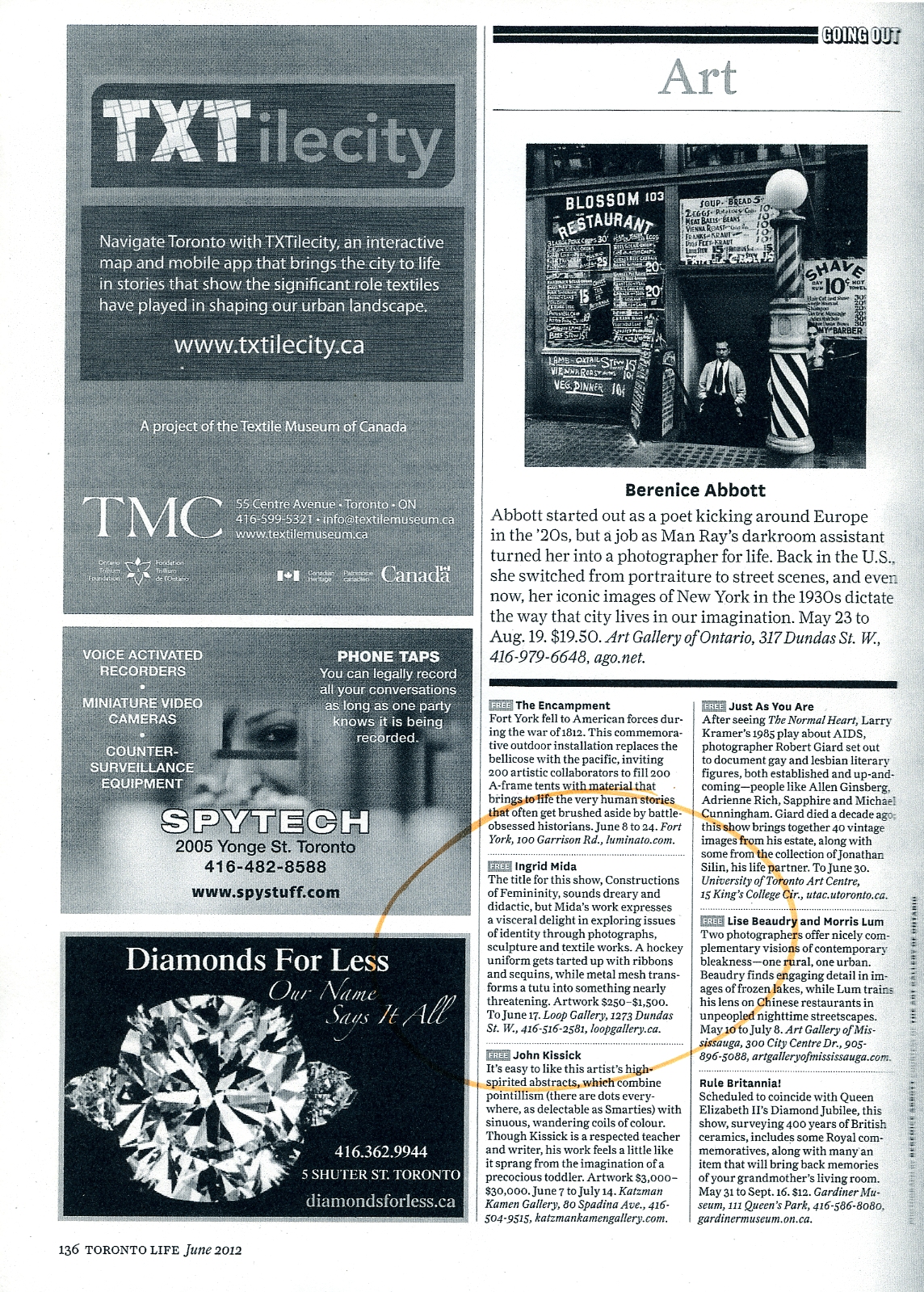
Toronto Life Magazine picked my show as one of five art shows to see in Toronto in June for their Going Out column. That is a real coup..... and I couldn't be happier. Getting this kind of publicity in the visual arts is a rare happening.


If you are in Toronto, please join me for the opening reception at loop Gallery on Saturday, May 26, 2012 from 2-5 pm. I will also be at the gallery on Sunday, May 27th from 1-4 pm. The show runs until June 17th, and that afternoon there will be a Question and Answer session from 2-3 pm.

Loop Gallery is located at 1372 Dundas Street West, Toronto. The gallery is open Wednesday to Saturday from noon to 5 pm and Sundays 1 to 4 pm.

 
Copyright © 2011. missbusinesscasual - All Rights Reserved
Proudly powered by Blogger