Showing posts with label Fashion and Art. Show all posts

Reflecting Fashion: Art and Fashion since Modernism

Wedding Dress 1967 by Christo at the Mumok, Vienna
The intersection of art and fashion is a topic that I never tire of, and the exhibition Reflecting Fashion at the Mumok in Vienna, Austria offers four floors of engaging examples that explore "clothing and fashion as an essential component of art".  The main themes of the exhibition include: Fashion as Modernism, Fashion as the eternal deputy of Surrealism, and From the Three-Piece Suit to the Deconstruction of Fashion.


Curators Susanne Neuburger in collaboration with Barbara Rüdiger explore the relationship between fashion, clothing and art, making reference to Charles Baudelaire in defining modernity through a concept of fashion and theorist Walter Benjamin in conferring a "revolutionary significance to fashion but also a certain primacy over art".


Regina Moller Dress and Photo at Mumok, Vienna
Some of the artists whose work is on display include Elsa Schiaparelli (Salvador Dali Lobster dress 1937), Ellsworth Kelly (Dress for Ann Weber 1952), Marcel Duchamp (Vest for Benjamin Peret 1958), Andy Warhol (Green Stamps Blouse 1965), Christo (Wedding Dress 1967), Cindy Sherman (Doll Clothes 1975 as well as photos from 1983-1990), among others.

Reform Dress early 1900s at Mumok, Vienna
This was an exhibition that I could have spent days in and I have to thank Valerie Steele for telling me about it. Valerie gave the keynote address "Is Fashion Art?" at the opening on June 15, 2012. This is an exhibition that I will long remember as offering one of the most comprehensive visual displays of the topic.

Reflecting Fashion: Art and Fashion since Modernism  
Exhibition runs until September 23, 2012
Mumok
MuseumQuartier, Museumsplatz 1, A-1070
Vienna, Austria


Fashioning the Object at the Art Institute of Chicago


In No Time Collection 2007, Hand-knitted Dress by Sandra Buckland, Image courtesy of the AIC

Fashioning the Object at the Art Institute of Chicago is an exhibition celebrating the innovative work of Bless, Boudicca, and Sandra Backlund. The practices of this group redefine fashion design into a conceptually based interdisciplinary process that sits on the intersection of art and fashion. Not driven by market forces, the work on display is intellectually engaging and exciting. 


The exhibition curator writes:  "Bless, Boudicca, and Backlund view fashion as a critical forum for dialogue and exchange, as well as an armature for understanding our place in the world. However, they endeavor to move beyond previous practices by drawing on an even greater spectrum of ideas inspired by disciplines as diverse as fine art, performance, design, and architecture to create work that responds to the social, political, and cultural environment and explores the creative process."


The exhibition is divided into three spaces which immerse the visitor into the work of the three designer groups. The first gallery features the work of Bless designers Desiree Heiss, who is based in Paris, and Ines Kaag of Berlin, who correspond daily through e-mail and Skype chats. The premise of their work is on the practice of altering or adding to existing objects to create new narratives, such as a hairbrush made of human hair - "like a jewelry case for hair".  The tactile qualities of this work invite touching and this is one of the few occasions when visitors are encouraged to do so. 

Bless Hair Brush, Image courtesy of the AIC


The second gallery is the largest and showcases the work of Boudicca founders Zowie Broach and Brian Kirkby. The video installations have a haunting narrative and highlight the “investigative rather than simply decorative” nature of the designers work. The video for their "Tornado Dress" can be viewed on YouTube here


The last gallery features the work of Sandra Backlund who creates ethereal knitwear to “consciously dress and undress parts of the body” in an effort to “highlight, distort, and transform the natural silhouette with clothes and accessories.” Delicate and armour-like at the same time, these garments transform the feminine shape into an artwork.


Pool Position by Sandra Backlund, Image courtesy of the AIC
I was enchanted and inspired by this exhibition of fashion as art. Intelligent, thoughtful and innovative are the words that come to mind. The exhibition at the Art Institute of Chicago runs until September 13, 2012. For more information, visit the AIC website here.

Fashion and Art, Canadian Style


Fashionality: 
1. One's personality expressed in their clothing, “fashion personality.” 
2. One's nationality expressed in their clothing, “fashion nationality.”

—The Urban Dictionary

Today is Canada's 145th birthday and it seemed like the perfect day to post about Fashionality: Dress and Identity in Contemporary Canadian Art at the McMichael Gallery in Vaughan, Ontario. I've extracted parts from the press release below to present an overview of the show, and it is clear that this would have been the perfect venue for my beaded and embroidered hockey equipment from my recent show Constructions of Femininity at loop gallery.

“Fashionality” is a newly coined play on words that refers to the visual culture and semiotics of dress and adornment. Combining the words “fashion,” “personality,” and “nationality,” it signals the interplay between clothing, identity, and cultural affinity. Taking the idiom of dress as a starting point, Fashionality: Dress and Identity in Contemporary Canadian Art explores the use of apparel in the work of twenty-three contemporary Canadian artists. It considers the diverse ways in which the clothed body and the idiom of dress are employed as sources of inspiration, humour, and critique, and as sites for the exploration of issues of identity, hybridity, and self-expression. Not strictly about fashion, the exhibition explores the ways in which the subjectivities and identities of those living in Canada are expressed, deconstructed, and reconfigured, while raising some intriguing questions about the embodied Canadian subject.

The exhibition is divided into four themes. The first gallery embraces the acts of creation and recreation. Here the focus is on artists whose work foregrounds relationships with nature, apparel-making, sports, and social media. Of note here are items of protective hockey equipment which have been embellished by living honeybees, an act orchestrated by Winnipeg artist Aganetha Dyck. Another project involves 365 days worth of hand-made clothing which was the result of a year-long daily dressmaking project blogged by Vancouver artist and designer Natalie Purschwitz. Asserting that First Nations not be relegated to the narratives of a primitive past, Oji-Cree artist KC Adams makes computer bags from fur and leather, and applies indigenous beading techniques to iPod and iPad holders.

The consecutive gallery considers the life cycle, and focuses on ghostly apparitions and unworn garments. Pointing to the domestic "uniform," the south wall is resplendent with hundreds of brightly-hued transparent aprons assembled by Newfoundland artist Barb Hunt. Conversely, the north wall seems to be alive with hundreds of tiny woolen sweaters, knitted by Ontario-based artist Michele Karch-Ackerman and several volunteers, in commemoration of Canadian soldiers who fell in World War I. In between these two astonishing assemblages are a number of intriguing works that speak to the vagaries of domestic life, real and imagined histories, the feminine “mystique,” and the confines of masculine imperatives.

The third gallery centers upon that quintessential Western symbol of woman: the dress. A blast of colour and energy, paintings and photographs hung here exude a love of cloth, colour, texture, and movement. Nicole Dextras's remarkable photographs of frozen gowns appear to dance next to Barbara Pratt's immaculate painted homages to haute couture. Waiting in the wings is a column of Gathie Falk's shoe boxes containing twelve pairs of colourful papier mâché pumps, while one of Barb Hunt's black plasma-arc cut flat steel dresses leans on a nearby wall.

In the final gallery the visitor becomes part of a conversation about culture and gender. Showcased here are works by a number of artists who have turned to clothing to express their personal, political, and cultural identities. Stereotypical renderings of Indian chiefs and squaws, lumberjacks, fashion models, and beauty queens are deconstructed and reconfigured through kitsch, camp, and a decided roasting of Canada's colonial imperatives. Lori Blondeau's Cosmosquaw cover girl, Kent Monkman's High-Heeled Moccassins, and Janet Morton's absurdly oversized plaid lumberjack shirt (entitled Canadian Monument #2), strongly suggest that any typecasting of Canada's diverse demographic is long overdue for a makeover.

The exhibition runs until September 3, 2012. Happy Canada Day!

Raquel Gaudard Interviews Me about Fashion as Art in the Museum


Not long ago, Brazillian journalist and editor Racquel Gaudard contacted me for an article she was writing for the publication Duetto. Her article was published last month and can be viewed here. Even if you don't understand Portugese, this publication is filled with beautiful imagery. Racquel also kindly provided me with a translation of the article into English for my blog.


When fashion in the museum became a synonym of art
By Raquel Gaudard

The 2012 calendar is full of great fashion exhibitions not to miss, however, the most awaited are – once again – happening far from Brazil.

The Metropolitan Museum of Art (MET) presents in New York, from May 10th to August 19th, “Schiaparelli and Prada – Impossible Conversations”. Elsa Schiaparelli and Miuccia Prada, parted by time and linked by style connections, get an exhibition that shows how both explored different angles of similar issues in their collections.

Heading to the old world, specifically to Paris, the Les Arts Decoratifs is ready to open its doors and face a huge line of fashion lovers, coming from all parts of the world – that´s what the exhibition  “Louis Vuitton - Marc Jacobs” is expecting – from March 9th to September 16th. In view of the extended time, the foresights point to a success as great as Alexander McQueen´s show, last year. Almost 700 thousand people passed by the event, a great amount, specially if we consider the contemporary art audience.

“Fashion exhibitions are in fashion”, says Ingrid Mida, Canadian artist and researcher of the intersection of fashion, art and history. “Fashion attracts young audiences into museums, and savvy curators are aware of the seductive power of staging exhibitions that will bring people into the museum”, she analyses.

Ingrid reminds us that it was Diana Vreeland who first presented, in a museum, the work of an living fashion designer, in 1983, when she showed off an Yves Saint Laurent retrospective, at the MET. “That exhibition generated a lot of controversy, but also set a precedent that others have since followed”. For Mida, fashion shows are more accessible to the mainstream perception than the traditional contemporary art installations, fact that explains – in her point of view – the big audience created by these events.


While abroad, fashion and arts have conversations in many dates spread all over 2012 calendar (check out our highlights for this year in the box, at the end of the report), in Brazil, this kind of production is still restricted to a more historical than artistic speech. The Costume and Textile Museum from the Feminine Institute, at Salvador city (BA), has the largest costume collection of the country, including, sometimes, special guides aimed at the dialogue between fashion and contemporary art – as proposed in the exhibition “Threads, threads, threads”, closed on March 22nd.

But this is an odd case and doesn’t describe the reality of our museums. According to Douglas Negrisolli, brazilian independent curator and art historian, the relation between fashion and visual arts in Brazil is still superficial. “The exclusiveness and the power of a small portion of the society are notorious in our country, and that comes about with much less strength in countries like United States, where the cultural production is extensively supported by both the government and private sector” – he considers.

Douglas also mentions how collections are limited to more regional representative costumes, such as cangaço (symbolical historical way of life from the Brazilian northeastern) and cerrado (typical brazilian vegetation), but, in the long run, “they are ineffective on the process of spreading brazilian costumes main feature, as well as its permanency in presentations”, he thinks.

About the art curator role due to this new work source, Ingrid Mida affirms that this professional acts as a gatekeeper into the museum, once through this selection of which and how objects are supposed to be displayed, he or she can change the public comprehension of art. “Schiaparelli and Prada”, for instance, is directed by no one less but the cineast Baz Luhrmann, who produced a video installation simulating an imaginary dialogue between the fashion designers. 


“Staging effects, such as the use of lighting and sound elements, invisible supports for garments, or animated mannequins, are display techniques for fashion objects that create the aura of an art installation. And, while audiences might read fashion as art because of those choices, it does not mean that what is shown in the context of a museum setting is necessarily art” – she completes.

In Douglas’ opinion, the art curator has the power of highlighting a production, but not raising it to another level. “Just as a physic reaction of an artist/stylist internal desire, in essence, is, on itself, an artwork”, he says. Concluding, he affirms that, in his opinion, “art is the expression of an intimate wish towards to something physical, visual, touchable” – so, clothing would also be, in a way or another, whether valued for installations around or not, included in these words.

BOX:
LOUIS VUITTON- MARC JACOBS
Museé des Les Arts Decoratifs – Paris
From March 9th to September 16th 2012
www.lesartsdecoratifs.fr

ELSA SCHIAPARELLI AND MIUCCIA PRADA – IMPOSSIBLE CONVERSATIONS
Metropolitan Museum of Arts (MET) – New York
From May 10th to August 19th 2012
www.metmuseum.org

CHRISTIAN LOUBOUTIN RETROSPECTIVE
Design Museum – London
From March 28th to July 1st 2012
www.designmuseum.org

YSL – THE RETROSPECTIVE
Denver Art Museum – Denver
From March 25th to July 8th 2012
www.ysldenver.com

BALLGOWNS: BRITISH GLAMOUR SINCE 1950
Victorya & Albert Museum – London
From May 19th to January 6th 2013
www.vam.ac.uk

DIANA VREELAND: THE EYE HAS TO TRAVEL
Palazzo Fortuny – Venice
From March 10th to June 26th 2012
www.museiciviciveneziani.it

What I'm Reading ....

Summer is my time to read. I love to lay in the backyard on a chaise and catch up on my reading.... Hot off the press from Berg are two new titles that dovetail my research: Fashion and Art as well as Victorian Fashion Accessories.


In Fashion and Art, editors Adam Geczy and Vicki Karaminas have compiled a selection of essays by leading scholars including Valerie Steele, Hazel Clark, Joanne Eicher and Diana Crane on the intersection of fashion and art. To date, papers on the topic were difficult to find and this book provides a comprehensive overview of the state of the discourse thereon. My initial review of this book indicates that Valerie Steele's essay on Fashion and Art in this book mirrors her comments in Milan as well as my interview with her for Fashion Projects. I am looking forward to digging deeper into these essays, especially since this is a topic that I am passionate about. 


In Victorian Fashion Accessories, Ariel Beaujot, who did her graduate studies at the University of Toronto, considers the history of women's fashion accessories such as the parasol, the glove and the fan during the Victorian era. Turning a phd thesis into a book that is accessible and interesting to non-academics is no small feat, and so far this book has been delightful, providing that necessary balance between scholarly research and general interest reading. In my own research on the paintings of James Tissot, I've noted that the glove and parasol figure prominently in his works, and I'm looking forward to understanding the nuances of meaning in the depiction of these accessories with the help of this book. 

Report from Milan Fashion Tales 2012

Dolci is the word I would use to describe my trip to Milan Fashion Tales 2012. It was three days of intense focus on fashion theory and I took it all in like a sponge. Funnily enough, many people said to me "You look familiar" and when I'd admit that I was the author of "Fashion is my Muse!", they would often laugh and said they had visited before. It seems that my slog (scholarly weblog) is a fashion academic's guilty pleasure.....
The Duomo in Milan, Photo by Ingrid Mida 2012
The conference was kicked off by fashion scholar Valerie Steele who gave a talk entitled "Is Fashion Art?". She had given a similar paper last summer but revised this talk to incorporate the quote from Muccia Prada used in the Costume Institute's exhibit on Schiaparelli and Prada: Impossible Conversations at the Metropolitan Museum of Art. Prada said: “Dress designing is creative, but it is not an art…. But to be honest, whether fashion is art or whether even art is art doesn’t really interest me. Maybe nothing is art. Who cares!

Window of Alan Journo in Milan, Photo by Ingrid Mida 2012
Other highlights of the conference included featured papers by Sophie Woodward on "The Intersecting Narratives in Clothing", Peter McNeil on "Post colonial fashion: Easton Pearson", and Chris Breward on "Music, Image and Style: David Bowie". During the parallel sessions, my favourite papers included: Jeffrey Horsley from London on "Presenting the Body in the Fashion Museum" and Alexandra Cabral from Lisbon on "Art and Fashion". No doubt there were other fabulous papers in other parallel sessions, butI focussed on my interest in fashion and art.

Blumarine Window Milan, Photo by Ingrid Mida 2012
I'm pleased to say that my paper "The Metaphysics of Blogging" was received well to a standing room only crowd. I quoted Agnes Rocamora from the University of the Arts in London and she just happened to be the next speaker on my panel and spoke on "Instant Fashion, Time and Acceleration in the Fashion Blogosphere". Marco Pedroni presented "Fashion Blogs, A New Way of Telling Fashion" and it was suggested that these three papers be published together since they reflect the past, present and future of the blog.

Window of Valentino in Milan, Photo by Ingrid Mida 2012
Milan turned out to be a beautiful city that combines fashion, art and history in its own unique way, and although I seemed to get lost at least once every day, there was always something beautiful around the next corner. The  theme of the city as it relates to fashion came up throughout the conference and there were speakers from countries all over the world including such faraway places as Brazil, South Korea, New Zealand, and Saudia Arabia. The conference organizers are already planning ahead to Milan Fashion Tales 2014.

I "heart" Milan. Photo by Ingrid Mida 2012


Fashion Tales 2012 Milan

This afternoon I will present my paper The Metaphysics of Fashion Blogging in Milan at the Fashion Tales 2012 conference. Of course, I wanted to wear something out of the ordinary and I asked a talented friend - Anna Zygowski - to create a dress for me. She first created a digitally printed silk fabric from photos of distressed lace and then copied a style of sheath dress that I often wear. The fabric presented its own challenges for Anna, but I think the result is fabulous. Even if my paper doesn't get rave reviews, no doubt the dress will!


The abstract of my paper is:

The emergence of the fashion blog is an aspect of culture that has gone largely unexamined. Although fashion blogs seem to be a relatively recent phenomenon, the drive to document aspects of one’s life goes back many centuries. Journals, diaries, sketchbooks and albums are evidence of the urge to memorialize and share ideas, events, activities, and accomplishments. For example, Barbara Johnson, a well-to-do Englishwoman from a clerical family, made detailed notes about her wardrobe for the period 1760-1823. Her album, which is now in the archives of the Victoria and Albert Museum, includes a detailed description of each garment, fabric swatches, information about cost and trimmings as well as clipped pocketbook engravings with the styles of the day. Drawing on historic precedents and the author’s experience as a blogger, blogs are reconsidered in the context of theorist Michel Foucault’s theories on the aesthetics of existence as creative portals for identity construction. In equating bloggers to Walter Benjamin and Charles Baudelaire’s concept of the flâneur, this social media tool is also recast as a forum in which the ephemeral and transitory processes of fashion can be captured. 

What is on the Fashion Calendar in June 2012

June seems relatively quiet compared to this past month! Some of the ongoing shows and events that I would recommend include:

Cristobal Balenciaga: Collectionneur de modes (Gallery Installation Shot by Ingrid Mida 2012)
Cristobal Balenciaga: Collectionneur de modes at the Musee Galliera in Paris
Balenciaga collected garments, accessories, and books from the 18th and 19th century as part of his personal archive. The juxtaposition of these items alongside the contemporary designs created by the Spanish designer show the links between the inspiration provided by history and the end result. This exhibition was so innovative in presentation that I think it is worth a closer look. The curators were creative in their display of items that could only be shown flat due to conservation issues, as well as innovative use of relatively inexpensive design modules. 

Prada and Schiaparelli: Impossible Conversations at the Metropolitan Museum of Art in New York
The imaginary conversation of two women designers -- Muicca Prada and Elsa Schiaparelli -- from different decades celebrates the power of ugly chic as well as the connection between fashion and art. Read my review on Fashion Projects here: http://www.fashionprojects.org/?p=3904


Roger Vivier: Process to Perfection (Gallery Installation Shot by Ingrid Mida 2012)
Roger Vivier: Process to Perfection at the Bata Shoe Museum in Toronto
The delicate jewel-like creations of Roger Vivier remind me of candy. Exquisitely crafted with beadwork and other embellishments, Vivier shoes are truly wearable works of art.

Fashion Tales 2012 in Milan (June 7-9)
If you happen to be in Milan next week, please join me at the Fashion Tales conference at the Universita Cattolica del Sacro Cuore. I will be speaking on the Metaphysics of Fashion Blogging on Friday, June 8, 2012 at 2:30-4 pm.

Constructions of Femininity Q&A at loop Gallery (June 17, 2012 at 3 pm)
On the last day of my show at loop, there will be a question and answer period moderated by Peter Legris. I know it is Father's Day, but since most guys will be out golfing, why not get a dose of art?


A Peak into the Gallery

Selected installation shots of Constructions of Femininity show a sampling of my work on display at Loop Gallery, Toronto.


Just prior to the opening an elderly man banged on the window, pointed at the sculpture called Isobel (named after Lord Stanley's daughter who played hockey), and asked me "What does this mean?" Not wanting to give him a long explanation, I simply replied: "Women used to play hockey wearing long skirts and it helped stop the puck". He said "Good" and continued on his way. One of the most amusing parts of this installation is watching the reaction of people passing by. I often see people stop dead in their tracks, point and then peer inside the window. It is literally a traffic stopper. Drop by the gallery if you can. The show at loop runs until June 17, 2012.


Constructions of Femininity


My art show/installation Constructions of Femininity at loop Gallery opens on Saturday, May 26, 2012. Work on this project has been underway for more than a year, and has happened in fits and spurts as I've juggled a myriad of research papers, speaking engagements and other things. It has been one of the busiest years of my life and at times I've wondered why I took on so much. I didn't know how I would juggle it all and I've been tempted to walk away this opportunity more than once, but my biggest fan and supporter, my husband, believed that I could do it and would not let me quit.

Constructions of Femininity is an exploration of the artifice of feminine dress and identity. This work juxtaposes the extreme silhouettes of 18th century dress with the armour of the modern day hockey warrior and was inspired by young women hockey players who have redefined femininity to include feats of courage, strength, and power. Hockey equipment has been transformed with feminine signifiers of ribbon, sequins and beading paired with silhouettes such as a romantic tutu or panier made out of armour-like mesh.

The choice of materials is designed to invoke a Canadian identity: mosquito mesh for a tongue and cheek reference to our mosquito infested north, aboriginal beading techniques referencing the trading practices which founded our country, and hockey equipment as a reference to our national sport. This work is intended to be a whimsical celebration of the power of sport to redefine femininity.

The photo that I used for my invitation only suggests at what will be on display, since the details of the beading are not evident in this photograph. There are seven hockey related sculptures, each unique in defining the construction of femininity.

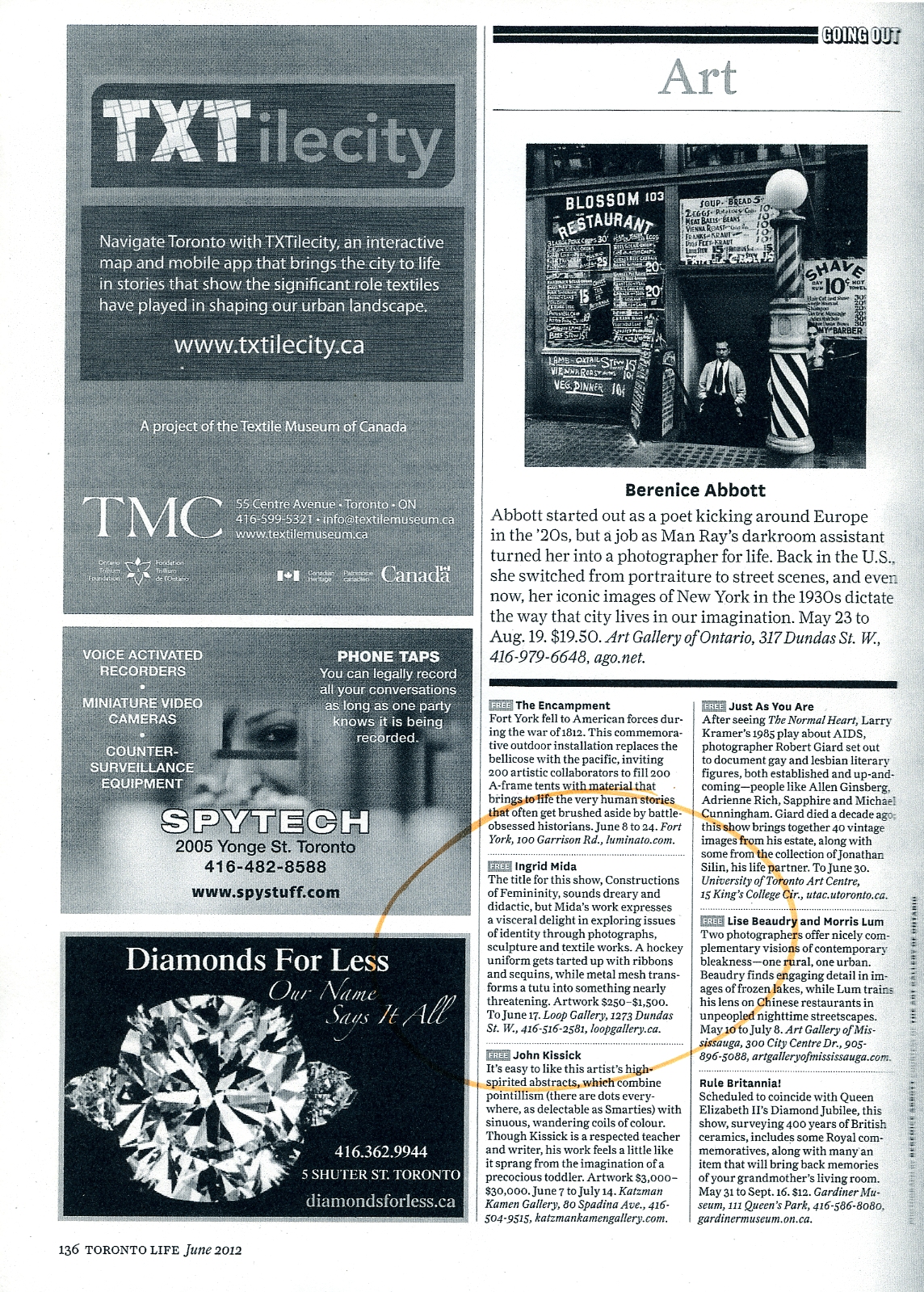
Toronto Life Magazine picked my show as one of five art shows to see in Toronto in June for their Going Out column. That is a real coup..... and I couldn't be happier. Getting this kind of publicity in the visual arts is a rare happening.


If you are in Toronto, please join me for the opening reception at loop Gallery on Saturday, May 26, 2012 from 2-5 pm. I will also be at the gallery on Sunday, May 27th from 1-4 pm. The show runs until June 17th, and that afternoon there will be a Question and Answer session from 2-3 pm.

Loop Gallery is located at 1372 Dundas Street West, Toronto. The gallery is open Wednesday to Saturday from noon to 5 pm and Sundays 1 to 4 pm.

Prada and Schiaparelli: Impossible Conversations

Surreal Body Gallery
Prada and Schiaparelli: Impossible Conversations
Courtesy of the Metropolitan Museum of Art

At the press preview yesterday for the Prada and Schiaparelli: Impossible Conversations at the Metropolitan Museum of Art, it seemed like there were three times as many press in attendance as compared to last year. It was a standing room only situation during the presentations by curators Harold Koda and Andrew Bolton, and inside the galleries, it was an elbows out scenario. Perhaps after the McQueen blockbuster, fashion in the museum has gained a new level of respect by the press. Seen in the crowd were Hamish Bowles, Robin Givhan, Bill Cunningham and Tavi Gavinson. My review for Fashion Projects was posted last night and can be read here.

Prada and Schiaparelli: Impossible Conversations opens to the public at the Costume Institute of the Metropolitan Museum of Art in New York City on May 10, 2012 and will run until August 19, 2012.

Art, Fashion and La Parisienne

Exhibition poster designed by Ingrid Mida 2012
I've been quiet on the blog front of late, because I've been deep into my research for my thesis, which I hope might one day become a book. I created these two posters to illustrate my project which is entitled Art, Fashion and La Parisienne

My work was inspired by a painting called La Demoiselle de Magasin (The Shopgirl) by James Tissot which is in the collection of the Art Gallery of Ontario. I soon discovered that this painting was one of fifteen large scale works in a series called La Femme à Paris painted by Tissot in 1883-85. Tissot made plans to issue series of etchings of the paintings, which were to be accompanied by short stories by leading authors of the period, including Émile Zola, Paul Bourget, Charles Gounod, and Alphonse Daudet. Despite Tissot’s earlier success as a painter, this series of highly polished paintings was not well received in either Paris or London. Tissot abandoned his plans to create prints of the paintings and the accompanying short stories.


La Femme à Paris  is a provocative series of narrative works showcasing the modern Parisian woman during a period of rapid change in the nineteenth century.  The series illustrates women from a range of income levels and occupations, rendered in precise detail using high key colours.

During the latter part of the nineteenth century, fashion and art were closely linked in Parisian society. Fashion was a subject of study and inspiration for artists, playwrights and poets. Descriptions of outfits worn by society women to the theatre, the opera and other social gatherings were routinely reported in the press. Many artists in France were influenced by the writings of Charles Baudelaire on fashion and modernity, especially his essay “The Painter of Modern Life” which was published in instalments in 1863 in the newspaper Le Figaro. In this essay, Baudelaire identified fashion as a way that artists could capture the processes of modernity in their work.

Using James Tissot’s series La Femme à Paris from 1883-85 as inspiration, my research will encompass an analysis of a selection of artworks, fashion plates and gowns from 1874-1886 to illuminate the intersection of art, fashion and modernity in the theme of la Parisienne.

I'm heavily immersed into my research, and I find the work utterly captivating. I now understand the origins of the modern icon of la chic Parisienne, images of which regularly grace the pages of blogs like French Essence, Fashion, Art and Other Fancies, Style in the City and of course, The Sartorialist.  

Although my blog posts might be a little less frequent, you can also find me on Pinterest, Facebook or Twitter.


My Upcoming Show at Loop Gallery


My upcoming exhibition at Loop Gallery in Toronto is entitled Constructions of Femininity and will run May 26 - June 17, 2012. In this exhibition, I explore the constructs of feminine dress and identity through photography, sculpture and textile works.

In this piece called "Samantha", hockey equipment has been transformed with feminine signifiers of ribbon and sequins and paired with a romantic tutu made out of armour-like mesh. The hockey-themed sculptures have been created to honour the young women hockey players who have redefined femininity to include feats of courage, strength, and power.

A Conversation with Jeanne Beker about Fashion and Art

Jeanne Beker: AGO Collector's Series 2011
Jeanne Beker's personal art collection is whimsical, eclectic, and captivating - descriptors that can also be used for the woman herself. In a one-on-one interview with this fashion powerhouse, Jeanne and I had a lively conservation about fashion and art and she also gave me a tour of her favourite artworks now on display as part of the Art Gallery of Ontario's 2nd Annual Collector's Series Exhibition.

The Birthday Party by Marion Perlet
For Jeanne, each work of art in her collection evokes a memory. She said "They really serve as a kind of visual diary for me of my travels, certain stages I was going through in my life, of certain changing aesthetics I've had over the years." One of her favourites is an oil painting by Marion Perlet called "The Birthday Party" in which the artist painted her memories of her birthday party as a child. Jeanne said "This was a cherry pie but my girls always thought it looked like a pepperoni pizza. It sat right over our table in the kitchen of our old house and now it hangs in my dining room and it just makes me feel good. And yet, there is something about the look in their eyes, some of them look a little dysfunctional, or that they have their grudges or own stories to tell or their own feelings about themselves, their particular plight - they are your typical dysfunctional family I think."

Toller Cranston gave Jeanne her first artwork and encouraged her to start her collection. He told her to buy Canadian art and "just chose one artist that you really like and go with it." Jeanne followed that advice and has several pieces from Marion Perlet. She offers advice to other collectors and said "Just buy what you love. Don't buy as an investment."

Yves Saint Laurent by Andre Rau
Jeanne's collection also includes several exquisite photographs by David LaChapelle, Paul Alexander and Andre Rau that capture the intersection of the fashion and art worlds. Jeanne was surprised when I told her about my interviews with Valerie Steele, Chief Curator of The Museum at FIT and Matthew Teitelbaum, Director/CEO of the Art Gallery of Ontario on the relationship between fashion and art. She said "I just think it is old fashioned to not see fashion as art. Of course, I'm talking about a particular kind of fashion. Fashion with a capital F, not fashion put out there for mass consumption." 

Jeanne and I agreed that fashion and art have a complex relationship. She put it this way: "There are a precious handful of designers [that would quality as artists]. I'm certainly not intimating that all of fashion  is art, not by a long shot. But I do think that there are some fashion creators who are, without question artists, in terms of the techniques that they have learned, in terms of the statements that they want to communicate or in what they are saying in their impact of their creations on humanity. I don't know what the definition of art is, if it is not that."

In closing my interview, I asked Jeanne if there was anything left on her list of things she wanted to do given her long list of accomplishments to date as television journalist, as well as author and editor. She answered "I'd like to return to the places I've been to for work that I didn't get a chance to explore on my own, but really what I look forward to doing in this next chapter is to continue doing a lot of things that I have done, but just do them better. I want to continue to make great television - but better; I want to write more books - but better." When I told her that she must have a wicked perfectionist streak because so many people look up to her and admire her that I cannot imagine her having to do anything better, she said "Sometimes I feel like I've barely scratched the surface in terms of my potential. I am turning 60 next year and that only gives me another 20-30 years to go, but who knows. Diana Vreeland didn't start editing Vogue until she was 60".  I left utterly enchanted by Jeanne and her zest for life. 

The AGO's 2nd Annual Collector's Series
AGO Art Rental + Sales Gallery
481 University Avenue
Toronto, Ontario
November 30, 2011 to December 19, 2011

For more information, see the AGO website link here.

P.S. Jeanne Beker's interview of Harold Koda as part of the Bata Shoe Museum's Founder Series Lecture was published yesterday in the Toronto Star. The link is here.

Harold Koda on Fashion in the Art Museum at the Bata Shoe Museum Founder's Lecture

Harold Koda (Photo by Karin Willis)
Last night, Sonja Bata introduced The Founder's Lecture series at the Bata Shoe Museum in Toronto as being part of a new initiative to bring "one truly outstanding personality" related to fashion to speak about their work. Harold Koda, the "rock star of fashion curators",  is the curator in charge of the Costume Institute at the Metropolitan Museum of Art in New York, was the first speaker in the series.

Harold's talk was entitled "The Arrangement: Fashion in the Art Museum" and traced the history of the costume collection at the Met from its earliest incarnation in 1947 as a resource collection for the fashion industry through to the present as one of the largest costume collections in the world.

The history of the Costume Institute is a story of personalities - from Diana Vreeland through to Richard Martin and Harold himself. An engaging speaker, both brilliant and humble, Harold kept all of us in rapt attention throughout his talk.

Not shy about the necessity of raising funds to support the Costume Institute, Harold mentioned the  strategies used by the museum to create excitement and raise funds for the collection. He gave credit to Diana Vreeland for recognizing that the annual party needed to have a high and glamorous profile in order that people would pay a lot of money to attend. He gave credit to Richard Martin who had the idea to create conceptually developed themes to generate audiences. Harold did not take any credit for himself, but he should have -- for his intra-museum collaborations for shows like "Dangerous Laisons" and his foresight in developing exhibitions of women of style like Jacqueline Kennedy and Nan Kemper as well as monographic designer displays like Chanel and Alexander McQueen.

Although fashion is one of the industries that drives the world economy, it seems that there is an uneasy relationship between fashion and finance and I was impressed that Harold addressed this head on. He said that when the museum presents a monographic designer exhibition (like Chanel), they often receive criticism as if there has been some kind of "collusion between high culture and the museum". And this problem is "complicated by fashion brands curating their own shows" in which the "concept never becomes as lucid as having someone outside the house reflect on it." Although the museum has to ask for the cooperation (and often sponsorship) of the fashion house, he made the point that "we are not working for the fashion company...we ask for access to their collection and archives...but there is a type of firewall between curation and the company."

Harold also talked briefly about the relationship between fashion and art and he mentioned that art is something that "elevates us beyond our daily experience". He gave examples of a few designers that he feels do this including Hussein Chalayn (and his airplane dress), Roberto Capucci who used "dress as a medium for sculpture" and Jean Paul Gaultier who uses "fashion as a vehicle for some other narrative". He said that the pattern for collecting at the Costume Institute is "focused more and more on the objects that have artistic virtue but are estranged from the experience of daily life".

To read more about Harold's views on the relationship between fashion and art, visit Fashion Projects here for the transcript of our conversation.

To join the Bata Shoe Museum and be at the front of the line for other illuminating talks and their upcoming show on Roger Vivier, visit their website here.

A Conversation with Valerie Steele on Fashion and Art

Valerie Steele 2007 Photo by Aaron Corbett (Courtesy of Valerie Steele)
Dr. Valerie Steele is a renowned fashion scholar. She is the Director and Chief Curator of the Fashion Institute of Technology, editor of the journal Fashion Theory and has written numerous books including  The Corset: A Cultural History; Paris Fashion; Fifty Years of Fashion: New Look to Now; Fetish: Fashion, Sex and Power; and Women of Fashion: 20th-Century Designers. She has curated more than twenty exhibitions including the current exhibition at FIT called Daphne Guinness.

In August, I spoke with Valerie about the convergence of fashion and art as part of my series of interviews with curators on the topic. The transcript of that interview was published on Fashion Projects and can be found here.
 
Copyright © 2011. missbusinesscasual - All Rights Reserved
Proudly powered by Blogger